


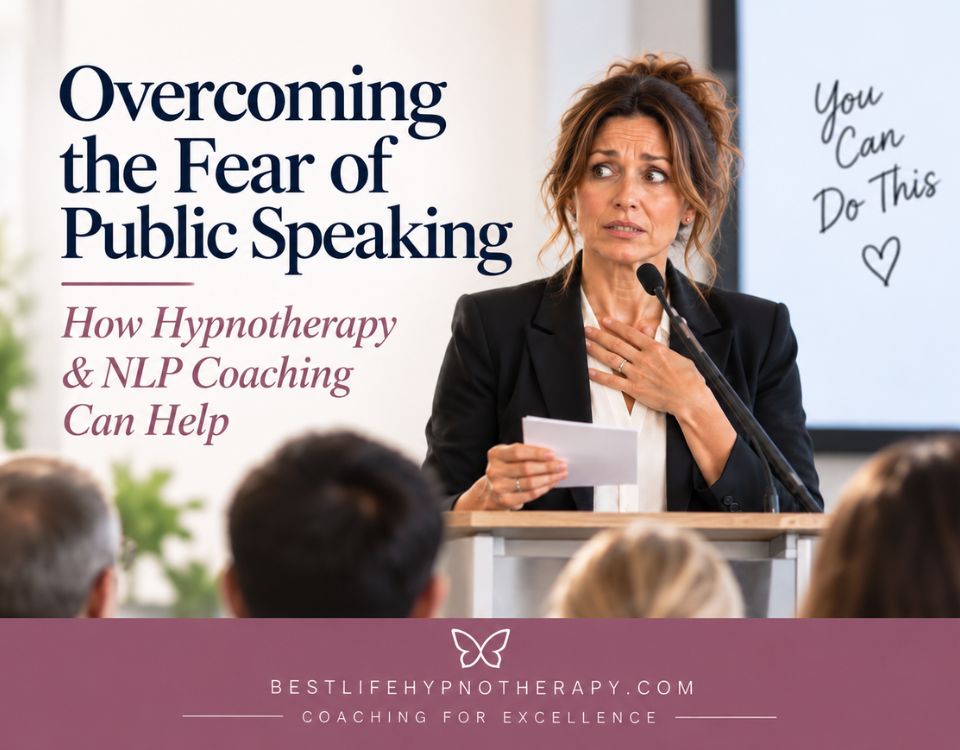
Your name is called.
You stand up.
You know exactly what you want to say.
And suddenly…
Your heart is pounding.
Your mouth is dry.
Your hands are shaking.
And the words you’ve practiced 20 times seem to have completely disappeared from your brain.
Welcome to the fear of public speaking.
You may be perfectly comfortable talking to five people around a conference table.
But put those same people in rows of chairs and ask you to stand in front of them?
Suddenly, everything changes.
Why?
And more importantly…
What can you do about it?
For many people, the fear isn’t really about speaking.
You speak all day long.
The fear is often about what might happen when other people are watching and evaluating you.
What if I forget what I’m going to say?
What if I sound stupid?
What if they can tell I’m nervous?
What if I embarrass myself?
What if I fail?
Underneath the fear of public speaking, there is often another fear:
The fear of being judged.
And once you start imagining all the things that could go wrong, your body may respond as though something actually is wrong.
Your heart beats faster.
Your breathing changes.
Your muscles tighten.
You may perspire.
And then you notice those physical reactions and think:
Oh no. I’m nervous.
Which can make you even more nervous.
It’s quite a cycle.
This is similar to what I discuss in How Hypnotherapy Helps Anxiety: What You Need to Know. Sometimes the thoughts we have about a situation can intensify the emotional and physical responses we’re already experiencing.
Here’s a question worth asking:
When did I decide that?
Maybe you had to stand in front of your class as a child and forgot what you were supposed to say.
Maybe other kids laughed at you.
Maybe a teacher embarrassed you.
Maybe you watched someone else freeze during a presentation and thought:
I never want that to happen to me.
Or maybe nothing particularly dramatic ever happened.
At some point, you simply started telling yourself:
“I’m terrible at public speaking.”
And each time you avoided speaking, you missed an opportunity to have a different experience.
Eventually:
“I get nervous when I speak in public”
can become:
“I’m just not a public speaker.”
But is that actually true?
Or is public speaking simply a skill you haven’t developed yet?
In How Human Programming Develops: The Hidden Influence of the Subconscious Mind, I explore how early experiences and the conclusions we draw from them can influence our beliefs and behaviors years later.
Sometimes we’re not responding to what’s happening today as much as we’re responding to what we learned to expect in the past.
People sometimes create an unrealistic goal for themselves:
“I’ll know I’ve overcome my fear when I’m not nervous anymore.”
But why?
Even experienced speakers can get nervous before walking onto a stage.
A little adrenaline doesn’t mean you can’t speak effectively.
Instead of telling yourself:
“I can’t be nervous.”
What if the goal became:
“I can feel nervous and still do this.”
Now you don’t have to fight the anxiety while simultaneously trying to give a presentation.
You can acknowledge it and keep going.
The words we use when describing ourselves and our experiences can make a difference. I explore this further in Your Mind Is Always Listening, where I discuss how repeated self-talk can influence our beliefs about what we’re capable of doing.
There’s an enormous difference between standing in front of an audience hoping you’ll remember what to say and standing there knowing you’ve prepared.
Know your opening.
Know your main points.
Know where you’re going.
Know how you want to finish.
And then practice it out loud.
Not silently in your head.
Out loud.
You don’t necessarily need to memorize every word. In fact, trying to remember a speech word-for-word can sometimes create additional pressure because forgetting one sentence can make you feel as though you’ve lost your place.
Know your material well enough that you can talk about it, rather than simply recite it.
You probably will.
I do.
Professional speakers do.
Everybody does.
You lose your place.
You stumble over a word.
You forget a point.
You say something differently than you rehearsed it.
And here’s something worth remembering:
The audience doesn’t have your script.
They don’t know what you were supposed to say.
If you leave out a sentence, they’re probably not sitting there thinking:
Wait a minute. She forgot paragraph four.
You know you made a mistake.
They may not.
One of the most valuable public-speaking skills isn’t learning how to give a flawless presentation.
It’s learning how to recover when it isn’t flawless.
Pause.
Take a breath.
Find your place.
Keep going.
That’s a skill, too.
Sometimes the pressure to be perfect comes from deeper limiting beliefs about failure, approval, and self-worth. In Rewire Limiting Beliefs With NLP Coaching and Hypnotherapy, I explore how recognizing those beliefs can create opportunities for healthier ways of thinking.
When you’re afraid of public speaking, your attention can become intensely focused on you.
How do I look?
Do I sound nervous?
What are they thinking about me?
Am I doing this right?
Try changing the focus.
Ask yourself:
What do I want THEM to get from this?
Maybe you want to teach them something.
Make them laugh.
Help them understand something differently.
Inspire them.
Give them information they can use.
Now you’re not standing in front of the room simply to be evaluated.
You’re there because you have something to give them.
That change in focus can make a big difference.
Mental rehearsal can be useful.
Picture yourself walking confidently to the front of the room.
See yourself looking at the audience.
Hear yourself delivering your opening.
Imagine yourself speaking clearly and comfortably.
And don’t just visualize everything going perfectly.
Imagine losing your place for a moment…
pausing…
finding it…
and continuing.
You’re rehearsing your ability to handle the experience, not your ability to be perfect.
Visualization can also be useful in other situations involving confidence and performance. In The Mental Game: How Hypnotherapy and Visualization Can Improve Athletic Performance, I explore how mental rehearsal can help people prepare for challenging situations.
But visualization isn’t a substitute for actually speaking.
At some point…
you have to do it.
Look for opportunities to speak in situations that feel manageable.
Speak up at a meeting.
Volunteer to make a presentation.
Give a toast.
Practice in front of friends.
You might also practice somewhere like Toastmasters, where people have an opportunity to develop and practice public-speaking skills in front of others.
Where you practice isn’t the important part.
The important part is that you practice.
If public speaking scares you, avoiding it feels pretty good.
Someone asks:
“Would you like to give the presentation?”
No, thank you.
Immediate relief.
The problem is that you may also be reinforcing the idea that speaking was something you needed to escape.
And the next time you’re asked to speak, the fear may still be there.
Sometimes the way we become more comfortable with something is by gradually giving ourselves new experiences with it.
Not necessarily by jumping immediately onto a stage in front of 1,000 people.
Start where you are.
Then stretch yourself a little.
Growth lives outside our comfort zone.
What if you prepare, practice and understand everything intellectually…
but the anxiety still takes over?
That’s when it can be useful to look at what’s happening beneath the conscious level.
In my work providing hypnotherapy Los Angeles, I help clients explore beliefs, emotional associations and subconscious patterns that may contribute to fears such as public speaking anxiety.
The underlying belief may be:
“If I make a mistake, people will think I’m stupid.”
“I have to be perfect.”
“I can’t handle embarrassment.”
“People are going to judge me.”
Or simply:
“I’m not good at this.”
Hypnotherapy can provide an opportunity to work with those deeper associations rather than focusing only on managing the physical symptoms of anxiety.
This connects with Sometimes the Pain Isn’t the Problem, where I discuss why the emotional reaction we notice isn’t always the underlying issue that needs attention.
Because sometimes the pounding heart isn’t the real problem.
The real problem is what you’ve decided that pounding heart means.
Through NLP Los Angeles, I also help clients examine how they’re representing an experience to themselves.
Think about what happens before you’ve even walked into the room.
Are you imagining yourself freezing?
Forgetting everything?
Seeing people judging you?
Feeling embarrassed?
In other words…
Have you already given the speech in your head and made it a disaster?
Your presentation hasn’t even happened yet.
But emotionally, you’ve already experienced the failure you’re afraid of.
Instead, you can begin creating a different internal representation.
Not:
“Nothing will go wrong.”
You don’t know that.
But:
“I’ve prepared.”
“I know my material.”
“I can handle being nervous.”
“If I make a mistake, I can recover.”
“I have something worth saying.”
That’s very different from demanding perfection.
In How Hypnotherapy and NLP Coaching Can Change Your Internal Dialogue, I explore how becoming aware of the conversations we have with ourselves can help us recognize and challenge unhelpful patterns.
We tend to think the sequence should be:
First I become confident. Then I’ll do it.
Sometimes it works the other way around.
You do something that scares you.
You discover that you can handle it.
You do it again.
You get a little better.
You do it again.
And eventually you have actual experiences to draw upon when your mind says:
“I can’t do this.”
Because now you can answer:
“Actually… I already have.”
That’s how confidence can grow.
Not because you waited for the fear to disappear.
Because you stopped letting the fear make the decision.
If fear of public speaking, performance anxiety, fear of judgment or lack of confidence is keeping you from speaking up professionally or personally, hypnotherapy and NLP Coaching can help you explore the beliefs and subconscious patterns that may be contributing to that fear.
And then comes the part that no amount of insight can replace:
Practice.
Because ultimately, becoming more comfortable speaking in public requires speaking in public.
Jayne Goldman, MBA, C.Ht., is the Founder and Principal of Best Life Hypnotherapy in Los Angeles. As a Certified Hypnotherapist and NLP Master Practitioner and Coach, she helps clients overcome anxiety, limiting beliefs, low self-esteem, self-sabotage, and other subconscious barriers to success. Through hypnotherapy, hypnosis, NLP Coaching, and Time Line Therapy®, she helps individuals create lasting behavioral change, build confidence, achieve emotional healing, and live more fulfilling lives.

